

Declined and Complex Loan Transactions: A Guide
Sometimes a good borrower can get declined because their loan does not fit into a lender’s standard policy. Other times a loan application gets declined because the scenario has been misunderstood or incorrectly presented to the wrong lender. There are many reasons for this and at the end of the day, it’s not always easy to tell why a loan has been declined.
When it comes to complex lending, we look at the structure, lender policy and the explanation of the scenario in question. Our goal is not to try and make the application fit within the lender’s policy. Rather, we aim to establish the true nature of complexity and then assess whether the scenario in question is actually financeable. We then establish the best lender to assess said application and present in the correct manner to ensure the best possible outcome.
What Is a Complex Loan Scenario?
A complex loan scenario is a situation where a borrower does not fit into a lender’s standard credit policy.
Self-employed income, trust structures, company income, tax debt, multiple properties, unusual loan securities, recent credit issues, large cash-out, non-standard property types, business debt, SMSF lending, bridging finance, construction finance, commercial property, declined applications from previous lending applications.
The borrower may still be a good borrower. It is just that their loan application needs more scrutiny by a lender.
Why Loans Get Declined
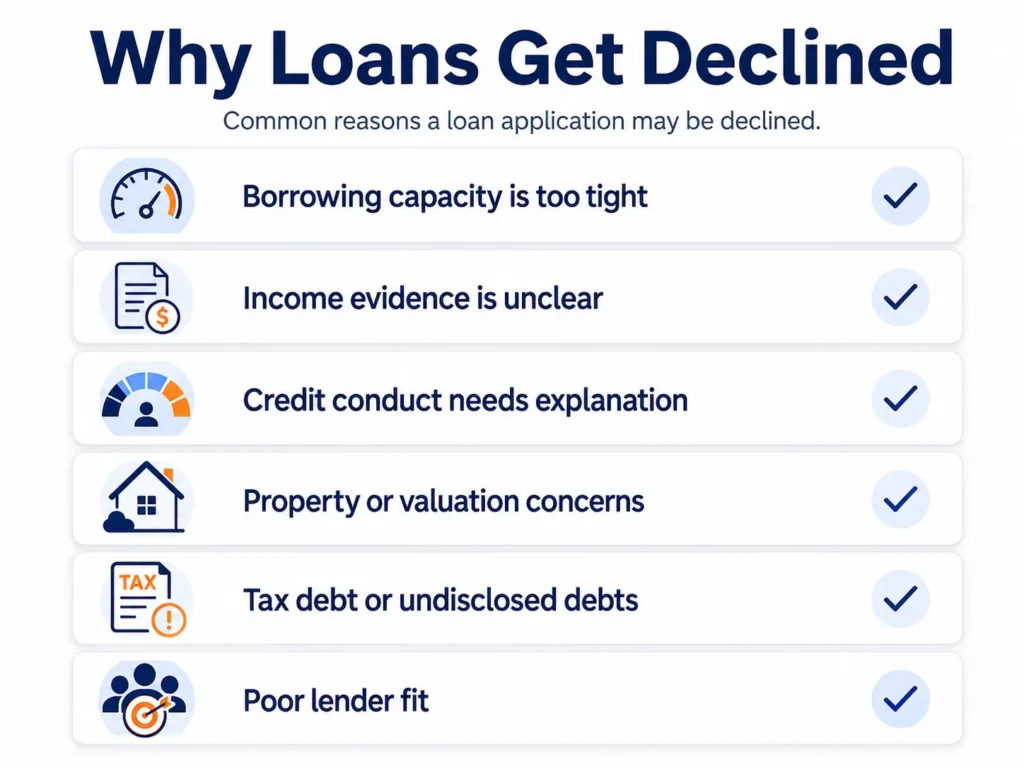
If you are asking ‘why was my loan declined’ then there are a number of common reasons for loan declines which need to be reviewed.
- insufficient borrowing capacity
- weak income evidence
- inconsistent bank statements
- credit history issues
- undisclosed debts
- unsuitable property
- valuation concerns
- tax debt
- unclear loan purpose
- poor lender fit
- incomplete documents
Understanding the reason for a decline in approval in the first place is half the battle for approval in a second application for a mortgage. If the same mistakes are repeated, then it is likely that approval will be denied again.
Poor-Fit Lenders
Choosing the wrong lender for your situation before applying is another common problem.
One of the most common mistakes when selecting a lender is choosing a lender BEFORE fully understanding the application scenario. The reason for this is simple: different lenders have different policies regarding what they will accept when it comes to income, property type, tax debt, etc. What one lender may decline for a given reason, another lender may approve with full explanation.
A declined application does not necessarily mean that you will not be approved for a loan with another lender. It is possible that the first lender you approached was not the best fit for your circumstances.
Self-Employed and Business Owner Complexity
Self-employed borrowers can present lenders with complexity due to nature of their income.
Company profit, retained earnings, trust distributions, add-backs, business debts, tax timing and fluctuating income etc will all need to be taken into account when assessing your mortgage application as a self-employed person or business owner.
Even a strong business owner may receive a mortgage declined if the application does not clearly highlight how the business income supports the self-employed individual to repay the loan. For a self-employed mortgage it is best to make the path from business income to personal borrowing capacity very clear.
Credit Issues
When you have had some credit issues in the past they don’t necessarily mean that you will be declined for a loan. It is just that the issues need to be understood by the lender.
Lenders will consider the type of credit issue you have had, the amount of the issue, the age of the issue, the reason for the issue, whether it has been repaid and your conduct since the issue.
Small past defaults that have been repaid in full are viewed in a different light to recent defaults of similar amount, especially where there are associated late mortgage payments or current hardship circumstances.
Cash-Out and Debt Consolidation Loans
Lenders often review cash-out and debt consolidation carefully.
Large cash-out requests, unclear business use of loan proceeds or even repeated debt consolidation are considered to pose greater risk than other purposes for which loans are required.
Large cash-out requests, unclear business usage and repeated debt consolidation are common reasons for loan declined.
Non-Standard Property or Security
Some properties are classified as non-standard in terms of how they are treated by the banks and are generally more difficult to finance than others. These can include for example rural properties, small apartments, mixed use properties, commercial property, specialised types of dwellings (such as certain types of factories, etc), property that is owned by a company, high-density properties and properties with certain valuation difficulties.
Even a good credit history can be negated by a difficult property.
How to Approach a Declined Loan
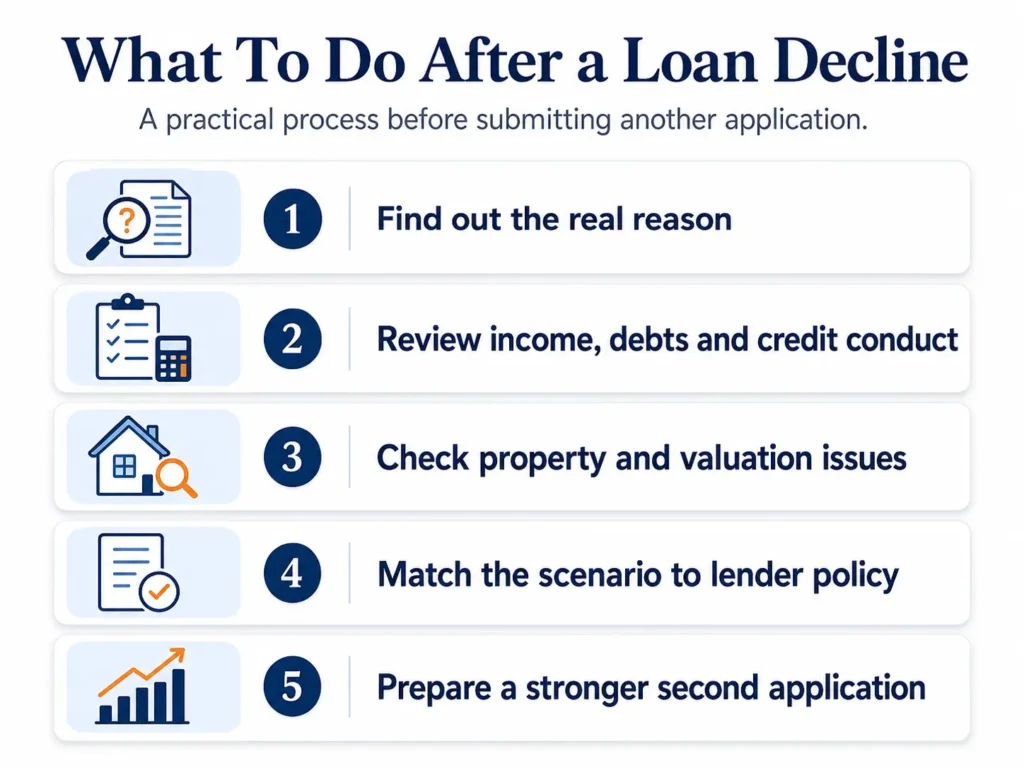
If you have searched for ‘loan declined what to do’ then start here! After you have had a loan declined do not apply for another loan straight away. Try to work out the REAL reason for the decline to the loan and obtain the feedback from the lender if possible.
Review the whole scenario – including your income, other debts, credit history, the property, the purpose of the finance, any relevant documents and the finance requirements of the lender/s that you are approaching. Also review the lender policy in full to understand all of the requirements.
A stronger second application should try to address the exact reasons for the decline of your loan application rather than hoping that another lender will ignore the same facts.
When Not to Reapply Immediately
There may be occasions where waiting to put in a new application would be wise – reducing your debt, cleaning up your bank statements, finalising off any outstanding tax returns, building up your savings, fixing up any credit issues or obtaining stronger documentation to support your loan application first.
Submitting multiple weak applications will make your situation worse.
How Evolve Helps With Complex Scenarios
Complex lending needs to be analysed thoroughly prior to lodging a loan application. The broker needs to have an understanding of the lender’s policy as well as the client’s circumstances and the reason for their loan application.
A good loan application clearly outlines why you need a loan, how you will repay it and why the lender has nothing to worry about.
Conclusion
A declined loan does not necessarily mean the end of the road for a loan. Approaching the next step with more care is often necessary.
At Evolve Lending & Finance we are able to review your declined loan applications, identify potential lenders and provide a structured loan submission to the most suitable lender, often with a successful outcome.