

Investment Property Loans: A Guide for Property Investors
Investment property loans help borrowers buy, hold or refinance property for investment purposes. They can be used by first-time investors, experienced landlords and portfolio investors looking to build long-term wealth.
But a good investment loan is not just about the interest rate. Structure, lender policy, rental income treatment, cash flow, interest-only strategy, offset use and future borrowing capacity for investment property can all affect the outcome.
This guide explains what investors should consider before choosing an investment property loan and how a thoughtful investment property loan structure can support long-term plans.
What Is an Investment Property Loan?
An investment property loan is a home loan used to buy or refinance a property that is not your principal place of residence.
The property may be rented to tenants, held for long-term growth, used as part of a broader portfolio or purchased with future plans in mind.
Investment lending is assessed differently from owner-occupied lending. Lenders usually consider rental income, existing property debt, expenses, tax position, borrowing capacity and whether the loan structure is suitable.
Why Structure Matters
Investors often focus on rate, but structure can be just as important.
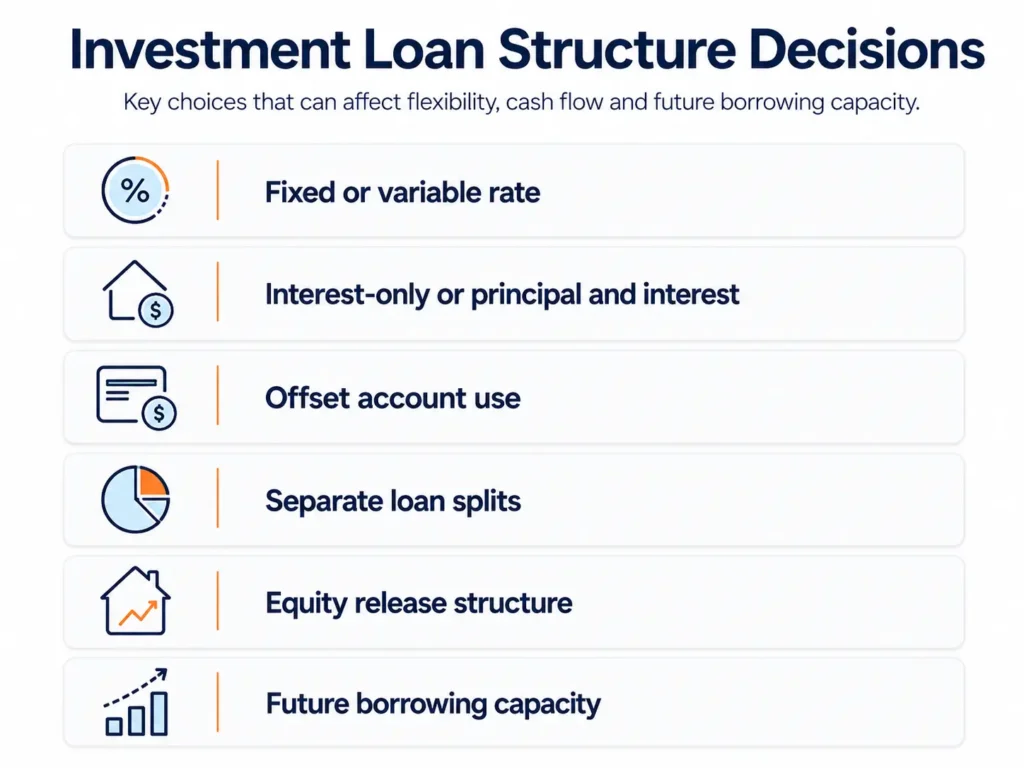
A strong structure may preserve flexibility, support future purchases, manage cash flow and make refinancing easier later. A poor structure may reduce borrowing capacity, mix deductible and non-deductible debt or create avoidable pressure.
Important decisions include fixed or variable rates, interest-only or principal and interest repayments, offset accounts, loan splits, ownership structure and use of equity.
Interest-Only vs Principal and Interest
Many investors consider interest-only investment loans to support cash flow. This can reduce monthly repayments during the interest-only period, but the loan balance does not reduce.
Principal and interest repayments gradually reduce debt, but repayments are higher.
The right option depends on cash flow, tax advice, future plans, risk appetite and lender policy. Interest-only lending is not automatically better for investors, and it should be reviewed in the context of the full strategy.
How Lenders Assess Investment Loans
Lenders usually assess:
- borrower income
- rental income
- existing debts
- living expenses
- deposit or equity
- credit conduct
- property type and location
- loan purpose
- repayment type
- existing investment portfolio
Rental income is often shaded, meaning the lender may only use part of the rent when calculating borrowing capacity. Existing investment debts may also be assessed at higher buffer rates.
This means lender choice can materially affect borrowing capacity for investment property.
Using Equity to Buy an Investment Property
Many investors use equity in an existing property to help fund the deposit and costs for an investment purchase. Using equity to buy investment property can be effective, but it needs to be structured carefully. Cross-collateralising properties can reduce flexibility in some cases. Separate loan splits may provide cleaner tracking and more control.
Investors should also allow for stamp duty, legal costs, inspections, vacancy, maintenance and cash buffers.
Cash Flow and Holding Costs
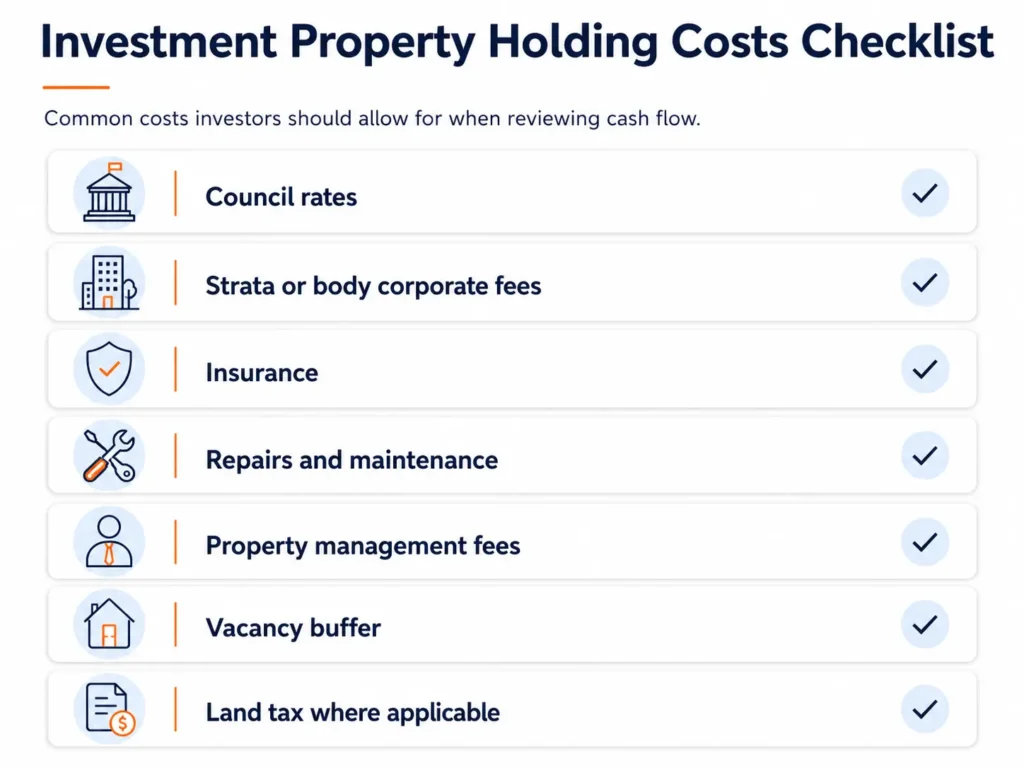
Investment property holding costs extend beyond the loan repayment. Investors need to allow for council rates, strata, insurance, repairs, property management fees, land tax where applicable, vacancy periods and maintenance.
A property that looks affordable on rent and interest alone may become tight once all holding costs are included.
This is why cash flow modelling matters before purchasing.
Tax Considerations
Investment property tax treatment can be important, but lending decisions should not be based on tax benefits alone. Understanding potential investment property tax deductions is helpful, yet it should be balanced with broader goals and risks.
Interest and some property expenses may be deductible depending on the circumstances. Depreciation may also be relevant for some properties.
Investors should seek tax advice before buying, refinancing, restructuring or drawing equity against investment property.
Common Mistakes
Common mistakes include choosing a lender based only on rate, using the wrong ownership structure, failing to separate loan purposes, underestimating holding costs or assuming rental income will be assessed at full value.
Another mistake is using all available equity without leaving cash buffer. Investment property can involve vacancy, repairs and rate changes, so liquidity matters.
Growing a Portfolio
For investors planning multiple purchases, the first loan structure matters. A lender that works for the first purchase may not support the second or third.
Portfolio planning should consider borrowing capacity, equity release, cash flow, ownership structure, lender exposure limits and future refinance options.
Conclusion
Investment property loans should be chosen with more than the next purchase in mind. The right structure can support cash flow, preserve flexibility and help investors move forward with a clearer strategy.
At Evolve Lending & Finance, we help investors assess borrowing capacity, equity position, lender fit and loan structure before they commit.